Forerunner
 The first mobile phone to incorporate PDA features was an IBM prototype developed in 1992 and demonstrated that year at the COMDEX computer industry trade show. A refined version of the product was marketed to consumers in 1994 by BellSouth under the name Simon Personal Communicator. The Simon was the first cellular device that can be properly referred to as a "smartphone", although it was not called that in 1994. In addition to its ability to make and receive cellular phone calls, Simon was able to send and receive faxes and emails and included several other apps like address book, calendar, appointment scheduler, calculator, world time clock, and note pad through its touch screen display. Simon is the first smartphone to be incorporated with the features of a PDA.
The term "smart phone" first appeared in print in 1995, for describing AT&T's "PhoneWriter Communicator" as a "smart phone".
PDAs
Personal digital assistantIn the late 1990s, many mobile phone users carried a separate dedicated PDA device, running early versions of operating systems such as Palm OS, BlackBerry OS or Windows CE/Pocket PC.[1] These operating systems would later evolve into mobile operating systems.
 In March 1996, Hewlett-Packard released the OmniGo 700LX, which was a modified 200LX PDA that supported a Nokia 2110-compatible phone and had integrated software built in ROM to support it. The device featured a 640x200 resolution CGA compatible 4-shade gray-scale LCD screen and could be used to make and receive calls, text messages, emails and faxes. It was also 100% DOS 5.0 compatible, allowing it to run thousands of existing software titles including early versions of Windows.
In August 1996, Nokia released the Nokia 9000 Communicator which combined a PDA based on the GEOS V3.0 operating system from Geoworks with a digital cellular phone based on the Nokia 2110. The two devices were fixed together via a hinge in what became known as a clamshell design. When opened, the display was on the inside top surface and with a physical QWERTY keyboard on the bottom. The personal organizer provided e-mail, calendar, address book, calculator and notebook with text-based web browsing, and the ability to send and receive faxes. When the personal organizer was closed, it could be used as a digital cellular phone.
In June 1999, Qualcomm released a "CDMA Digital PCS Smartphone" with integrated Palm PDA and Internet connectivity, known as the "pdQ Smartphone"
In early 2000, the Ericsson R380 was released by Ericsson Mobile Communications,and was the first device marketed as a "smartphone". It combined the functions of a mobile phone and a PDA, supported limited web browsing with a resistive touchscreen utilizing a stylus.
In early 2001, Palm, Inc. introduced the Kyocera 6035, which combined a PDA with a mobile phone and operated on Verizon. It also supported limited web browsing.
Smartphones before Android, iOS and BlackBerry, typically ran on Symbian, which was originally developed by Psion. It was the world's most widely used smartphone operating system until the last quarter of 2010.
Mass adoption
 In 1999, the Japanese firm NTT DoCoMo released the first smartphones to achieve mass adoption within a country. These phones ran on i-mode, which provided data transmission speeds up to 9.6 kbit/s.Unlike future generations of wireless services, NTT DoCoMo's i-mode used cHTML, a language which restricted some aspects of traditional HTML in favor of increasing data speed for the devices. Limited functionality, small screens and limited bandwidth allowed for phones to use the slower data speeds available.
The rise of i-mode helped NTT DoCoMo accumulate an estimated 40 million subscribers by the end of 2001. It was also ranked first in market capitalization in Japan and second globally. This power would wane in the face of the rise of 3G and new phones with advanced wireless network capabilities.
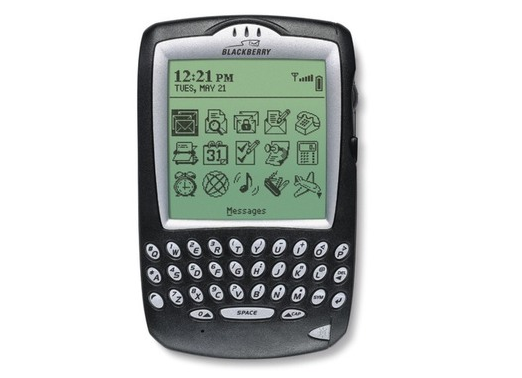
Outside of Japan smartphones were still rare, although throughout the mid-2000s, devices based on Microsoft's Windows Mobile started to gain popularity among business users in the U.S. The BlackBerry later gained mass adoption in the U.S., and American users popularized the term "CrackBerry" in 2006 due to its addictive nature. The company first released its GSM BlackBerry 6210, BlackBerry 6220, and BlackBerry 6230 devices in 2003.
Symbian was the most popular smartphone OS in Europe during the middle to late 2000s. Initially, Nokia's Symbian devices were focused on business, similar to Windows Mobile and BlackBerry devices at the time. From 2006 onwards, Nokia started producing entertainment-focused smartphones, popularized by the Nseries. In Asia, with the exception of Japan, the trend was similar to that of Europe.
Android and iOS
 In 2007, Apple Inc. introduced the iPhone, one of the first smartphones to use a multi-touch interface. The iPhone was notable for its use of a large touchscreen for direct finger input as its main means of interaction, instead of a stylus, keyboard, or keypad typical for smartphones at the time.
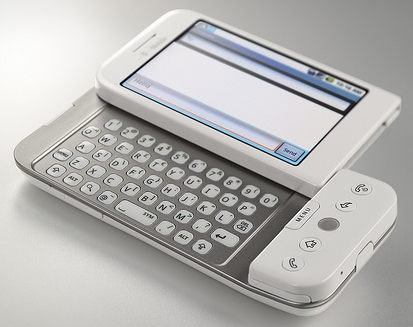 2008 saw the release of the first phone to use Android called the HTC Dream (also known as the T-Mobile G1). Android is an open-source platform founded by Andy Rubin and now owned by Google. Although Android's adoption was relatively slow at first, it started to gain widespread popularity in 2010, and now dominates the market.
These new platforms led to the decline of earlier ones. Microsoft, for instance, started a new OS from scratch, called Windows Phone. Nokia abandoned Symbian and partnered with MS to use Windows Phone on its smartphones. Windows Phone then became the third-most-popular OS. Palm's webOS was bought by Hewlett-Packard and later sold to LG Electronics for use on LG smart TVs. BlackBerry Limited, formerly known as Research In Motion, also made a new platform from scratch, BlackBerry 10.
The capacitive touchscreen also had a knock-on effect on smartphone form factors. Before 2007 it was common for devices to have a physical numeric keypad or physical QWERTY keyboard in either a candybar or sliding form factor. However, by 2010, there were no top-selling smartphones with physical keypads.
